To approach spooky small stream trout, stay low, move deliberately upstream from behind the fish, and keep your silhouette below the skyline. Trout view the surface through an optical window called Snell's Window (roughly a 97-degree cone); crouching flattens your angle to the water, keeping you invisible outside their primary cone of vision while eliminating ground vibrations.
Late autumn strips away every illusion an angler clings to. The thick mountain canopy has dropped its leaves, stream flows have trickled down to bare-bones clarity, and the water is so crystalline you can count the pebbles six feet down. On headwater freestones and meadow creeks, wild trout do not behave like hungry opportunists right now. They behave like paranoid fugitives living under constant drone surveillance from kingfishers, mergansers, and osprey.
If you stomp up to a pool wearing a high-visibility rain jacket and wave a twelve-foot rod through the air like a marching band baton, the fish will vanish into undercut banks before your fly even leaves your hand. Catching these pressured fish requires understanding stream optics, sound physics, and predatory patience. Stealth wading and approaching spooky small stream trout is not about crawling around in full military camouflage; it is simply about working with the physical laws of the creek rather than against them.
Understanding the Trout Cone of Vision
To avoid blowing up a pool, you must understand how a fish sees you. Because light refracts when entering water, a trout does not see the above-water world the same way a hiker does. Light bends at the air-water boundary, creating an optical phenomenon known as Snell's Window.
From the trout's perspective looking upward, the entire hemispherical world above the water is compressed into an optical cone measuring roughly 97 degrees across. Everything directly above the fish is clearly visible within this circular window. Outside that cone, the underside of the water surface functions like a mirror, reflecting the stream bottom back down at the trout. If you stand upright on an exposed cobble bar, your head and torso penetrate high into that 97-degree cone, looming over the fish like a giant silhouette against the bright autumn sky.
The mathematical fix is straightforward: drop your physical elevation. When you crouch, kneel, or fish from behind a boulder, you push your silhouette below the critical refraction angle (roughly 48.6 degrees from the vertical). As long as you stay outside that critical cone, the underside of the surface conceals you behind surface glare and internal reflection. The shallower the pool, the narrower Snell's Window becomes, which means on shallow fall tailouts, staying low is non-negotiable.
Fishing Upstream vs Downstream Tenkara
One of the earliest strategic decisions you make on any creek is your direction of travel. When discussing fishing upstream vs downstream tenkara, the physics of fish positioning dictate the playbook.
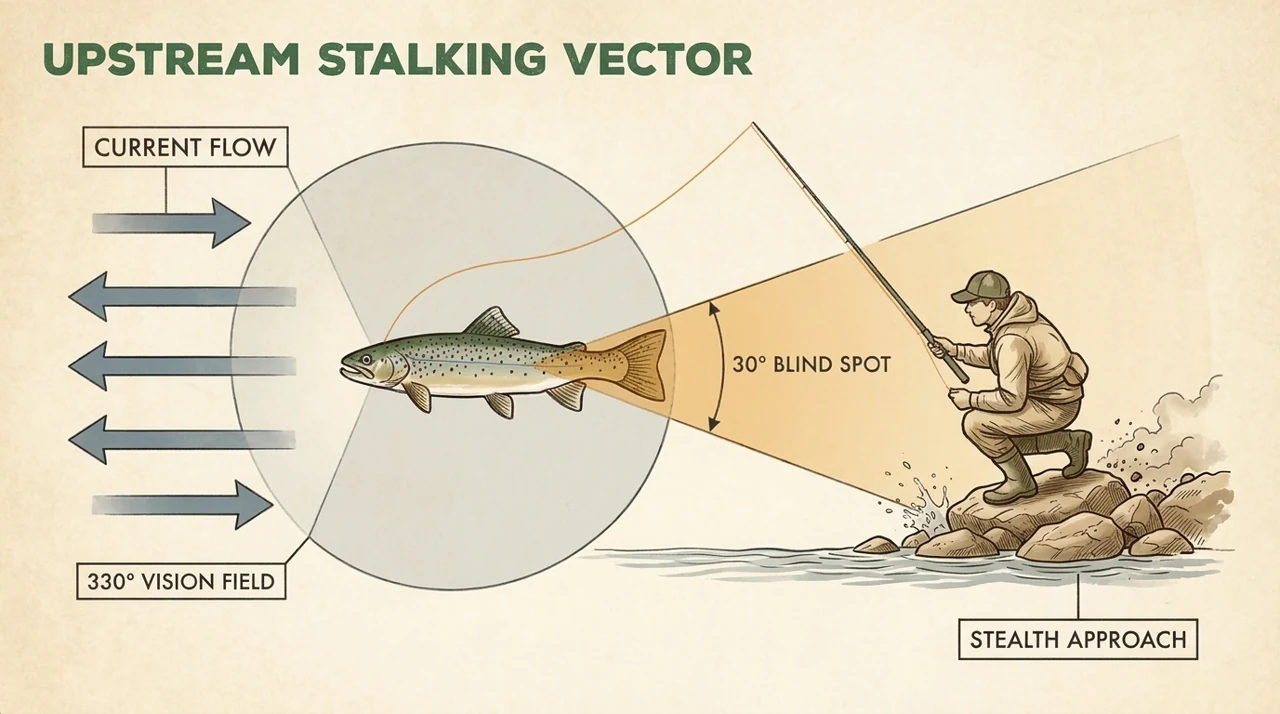
Trout orient themselves facing into the current to intercept drifting food and keep oxygen passing over their gills. Because their eyes are set on the sides of their head, their forward and peripheral vision is exceptional, but they possess a blind spot directly behind their tail, roughly spanning thirty degrees. Approaching from downstream allows you to stalk up directly inside that blind pocket. For tight-line presentations, moving upstream lets you keep your line off the water and avoid dragging unnatural wakes across the pool.
Are there exceptions? Occasionally. In tight mountain pockets bordered by steep gorge walls, casting straight downstream with an extended drift—a technique often used during specialized fall tenkara tactics—can allow you to dangle a kebari in front of an undercut boulder without entering the pool at all. However, as a baseline rule for spooky water, work upstream. You cast to fish looking away from you, and any sediment kicked up by your boots washes behind you, rather than alerting the fish ahead.
Tactical Approaches by Water Type
Different stream structures present unique visual and acoustic challenges. Adjust your approach based on the specific water you are stalking:
| Water Structure | Trout Awareness Level | Primary Stealth Hazard | Tactical Adjustment |
|---|---|---|---|
| Glassy Tailouts | Maximum (Paranoid) | Surface ripples and overhead silhouette | Kneel far back; cast a long, fine tippet across the lip from below the pool. |
| Plunge Pool Pockets | Moderate (Relying on white water) | Rod tip flash over the foam line | Stand closer, stay low, and hide behind the rim rocks to dap the pocket. |
| Undercut Meadow Banks | High (Vibration sensitive) | Heavy bank-side footsteps causing ground shock | Wade in mid-channel instead of walking the soft turf bank; cast parallel to turf. |
| Riffle Runs | Low to Moderate (Broken surface) | False casting over active feeding lanes | Keep your cast low, using sidearm deliveries below the tree canopy line. |
Acoustic Footprints: Silent Wading Mechanics
Sound travels more than four times faster through water than through air. When you dislodge a river rock with your wading boot, that sharp clack resonates down the entire pool channel like a gunshot. The problem is rarely human speech; trout do not care if you whisper to your buddy. They care about substrate shockwaves and grinding gravel.
To move silently through spooky runs, apply these mechanical rules:
- Toe-First Stepping: Never plant your heel down with your full body weight. Slide your toes forward, feel for stable substrate beneath the current, and gently shift weight onto your foot.
- Wade Outside the Water: If dry gravel or large stable rocks sit along the bank, walk on them rather than inside the stream margin. Every step taken on dry stone eliminates a water shockwave.
- Avoid Silt Plumes: Stepping into mud deposits or fine sand creates downstream plumes. Even if the fish does not flee from the cloud itself, unnatural turbidity puts wild trout on immediate defensive alert.
- Cast From Further Back: Dialing in your tenkara line length allows you to keep an extra rod-length of buffer between you and the pool lip, minimizing the need to wade deep into prime feeding territory.
Clothing Colors for Clear Creeks
Anglers spend hours obsessing over thread color on a size 16 dry fly while wearing a bright royal-blue fleece or a blazing red cap. In autumn, riparian corridors transition into deep ambers, weathered grays, muted olives, and charcoal slate. Bright primary colors and stark white hats stand out against fall foliage like a beacon.
When selecting clothing colors for clear creeks, choose earth tones that mimic your backdrop: foliage greens, olive drabs, muted browns, and medium stone grays. Slate gray is arguably the most versatile shirt color because it blends seamlessly with both overcast autumn skies and riverside granite boulders. Remember that your hat is the highest point on your body; choosing an olive or drab tan cap keeps your crown from looking like a target against the tree line.
Profile Management and Rod Flash
Even with earth tones and quiet steps, careless movement will blow your cover. Trout are hardwired to spot sudden, rapid motion. A slow, steady crawl rarely triggers an emergency flight response, but an abrupt arm swipe or an erratic rod wave will scatter every fish in sight.
Modern glossy fly rods frequently cause rod flash—a reflected glare of sunlight off the blank that strobes across the water during a cast. Keep your casting stroke compact, low, and smooth. Use sidearm casts under overhanging branches rather than towering overhead deliveries that swing through Snell's Window.
Carrying excessive gear swinging from your chest also compromises your stealth profile. Bulky chest packs stick out from your frame and force you to stand taller. A streamlined option like the Sumato Dual-Rod Quiver Sling Pack keeps spare tackle and secondary rods tucked neatly behind your back, letting you bend at the waist or drop to both knees without gear dragging in the current or snagging on low-hanging alder branches.
The Stalking Routine: Read Before You Step
The biggest tactical error anglers make on skinny autumn creeks is casting too soon. When approaching a new run, stop at least twenty feet downstream of the tailout. Crouch down, stay still for sixty seconds, and observe. Look for the faint rhythmic flash of a white mouth opening on the bottom, the subtle push of water along a seam, or a dorsal fin breaking through a glassy glide.
Once you spot the target, plan your route. Identify which boulder will hide your knees, where you will set your feet, and where your fly needs to land to avoid lining the fish. Catching spooky trout in low water is an exercise in predatory discipline: step deliberately, stay low, blend into the backdrop, and let the fish feed unhurriedly until the kebari drops quietly into its path.